
I get asked this question more than you’d think — usually by someone halfway through a home renovation, or a student staring at a geometry worksheet at 11 PM, typing “wait, is this perimeter or area” into Google. Fair question. The words get thrown around like they mean the same thing, and honestly, textbooks don’t always help.
So let’s clear it up properly, once and for all. No jargon, just the actual difference and when each one matters.
Perimeter: The Outline
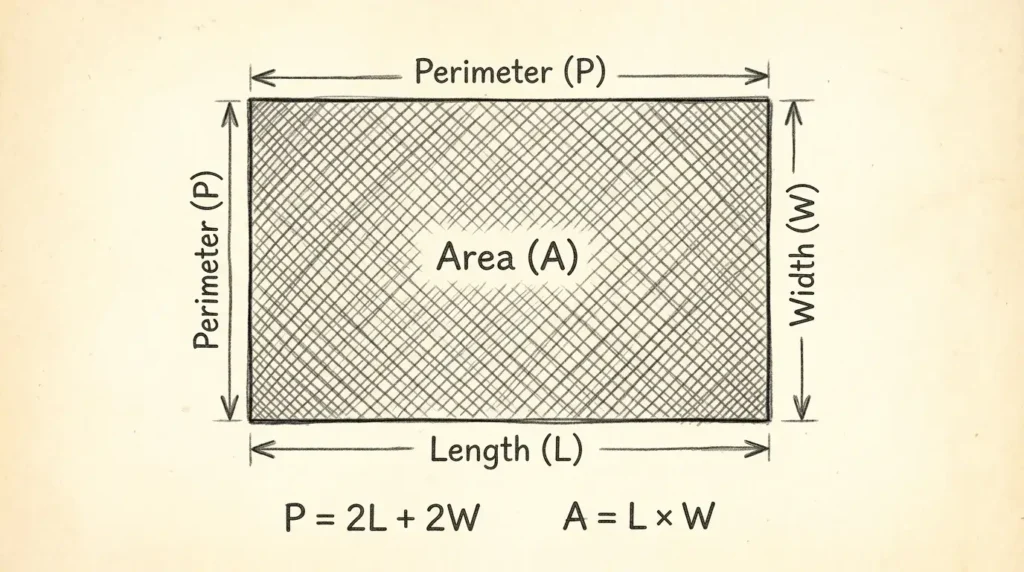
Perimeter is just the total length around the edge of a shape. That’s it. If you walked along the boundary of your backyard, the total distance you covered is the perimeter.
Formula for a rectangle: P = 2(length + width)
Say your yard is 10m by 6m: P = 2(10 + 6) = 32 meters
That 32 meters is exactly how much fencing wire you’d need to go all the way around. This is why perimeter matters most when you’re dealing with boundaries — fencing, wall borders, picture frames, or trim work.
You can check this instantly with our Perimeter Calculator — works for squares, triangles, circles, and even irregular shapes like kites and trapezoids.
Area: What’s Inside
Area is the space contained within that boundary. Same yard, same 10m by 6m rectangle:
A = length × width = 10 × 6 = 60 square meters
Notice the units changed — meters became square meters. That’s the biggest giveaway that you’re dealing with area instead of perimeter. Whenever you see “sq” or a little “²” next to the unit, someone’s talking about area, not the boundary.
Area is what you need when you’re buying grass seed, laying tiles, painting a wall, or figuring out how much carpet to order. You don’t need to know the boundary length for any of that — you need to know how much surface you’re covering.
Try it yourself on our Area Calculator if you’re working out material quantities for a project.
Circumference: Perimeter’s Circular Cousin
Here’s a small detail that trips a lot of people up — circumference isn’t a separate concept from perimeter. It’s literally the perimeter of a circle. We just use a different word because circles don’t have straight sides to add up.
C = 2πr (or πd, if you know the diameter)
A circle with a 5m radius has a circumference of: C = 2π(5) ≈ 31.4 meters
Same logic as perimeter — it tells you how much material you’d need to wrap around the edge, whether that’s a garden border, a wheel, or a round table edge.
Our Circumference Calculator handles this along with related shapes like semicircles and sectors.
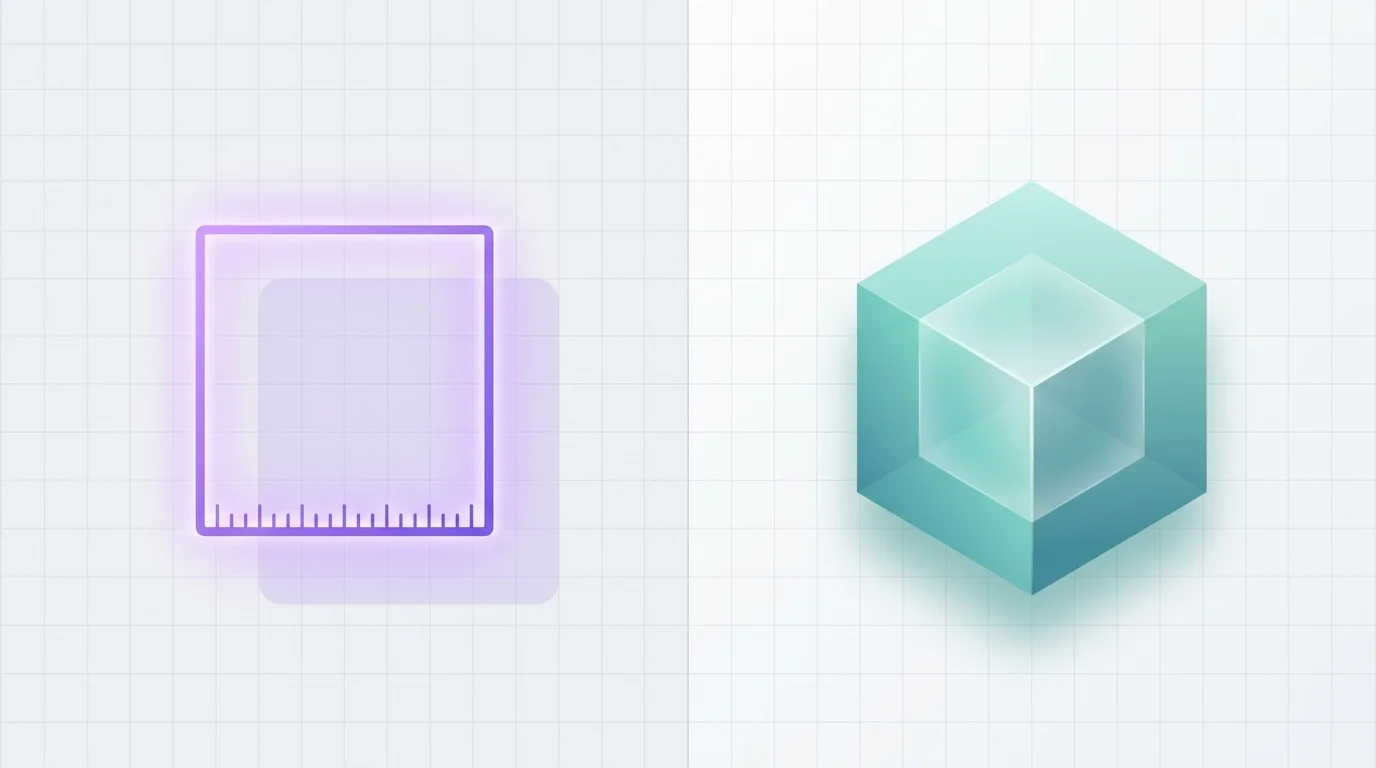
[IMAGE INSERTION POINT 2 — side-by-side comparison of a flat shape (2D, perimeter/area) versus a solid shape (3D, surface area/volume)]
Surface Area: Area’s 3D Version
Once you move from flat shapes to solid objects, things stretch into a third dimension, and “area” becomes “surface area” — the total area of every face of a 3D object added together.
Take a cube with 4m sides: Surface Area = 6 × side² = 6 × 16 = 96 square meters
This matters the moment you’re covering the outside of something solid — wrapping a box, painting a shed, tiling a swimming pool, or working out how much fabric covers a tent.
Check it with our Surface Area Calculator for cubes, spheres, cylinders, cones, and more.
Volume: The Space Inside a Solid
Volume is where things finally go 3D all the way through — it’s how much space is inside a solid object, measured in cubic units.
Same cube: Volume = side³ = 4³ = 64 cubic meters
This is what you need for water tanks, concrete pours, shipping boxes, or figuring out how much soil fills a raised garden bed. If area tells you “how much surface,” volume tells you “how much fits inside.”
Our Volume Calculator covers all the common solids you’ll run into.
Quick Way to Remember the Difference
| Concept | Dimension | Unit | Answers |
|---|---|---|---|
| Perimeter | 1D (boundary) | m, ft, cm | “How far around?” |
| Circumference | 1D (circular boundary) | m, ft, cm | “How far around a circle?” |
| Area | 2D (flat surface) | m², ft² | “How much flat space?” |
| Surface Area | 2D (surface of a solid) | m², ft² | “How much outer covering?” |
| Volume | 3D (space inside) | m³, ft³ | “How much fits inside?” |
If you’re ever stuck mid-calculation, just look at the unit. No square or cube symbol means you’re measuring a boundary. One square symbol means flat area. A cube symbol means volume.
Frequently Asked Questions
Is circumference the same as perimeter?
Yes — circumference is just the specific term used for the perimeter of a circle.
Can two shapes have the same perimeter but different areas?
Absolutely, and this trips people up constantly. A long thin rectangle and a square can have identical perimeters but very different areas. A 4×4 square has a perimeter of 16 and area of 16. A 1×7 rectangle also has a perimeter of 16, but its area is only 7.
Do I need area or perimeter for fencing a yard?
Perimeter. Fencing goes around the boundary, so you only need the total edge length, not the enclosed space.
Do I need area or volume to buy paint?
Depends what you’re painting. A flat wall needs area. A 3D object like a tank or box needs surface area, since you’re covering its outer faces.
Why does the ellipse perimeter formula look so complicated compared to a circle?
Circles are perfectly symmetric, so their perimeter has one clean formula. Ellipses aren’t symmetric in the same way, so there’s no single exact formula — just very close approximations, which is standard practice in engineering.
Final Thoughts
Once you separate these five ideas by what question they actually answer — “how far around,” “how much flat space,” “how much fits inside” — the confusion mostly disappears. The names sound similar, but they’re solving completely different problems.
If you’ve got the numbers for your shape ready, just plug them into whichever calculator matches your question: